
Discovery Platform Focused on Progression
DaCapo Brainscience is combining data science and human biology to identify small molecules that can slow or halt progression of neurodegenerative disease.
Modifying Disease Progression
The greatest unmet need in neurodegenerative disease is the development of new medicines to treat disease progression, particularly for people with sporadic disease. This contrasts with approaches that target risk factors after the disease has manifested or that target only rare forms of the disease.
Meeting this need requires discovering and drugging new targets, beyond those currently on the radar. Parkinson’s disease, and other neurodegenerative disorders, are heterogeneous in nature but our approach enables the identification of patient subsets, and we will match treatments accordingly. To uncover such new biology, we use human data as a starting point, while not being constrained by preconceived assumptions about disease biology.
Discovery Platform
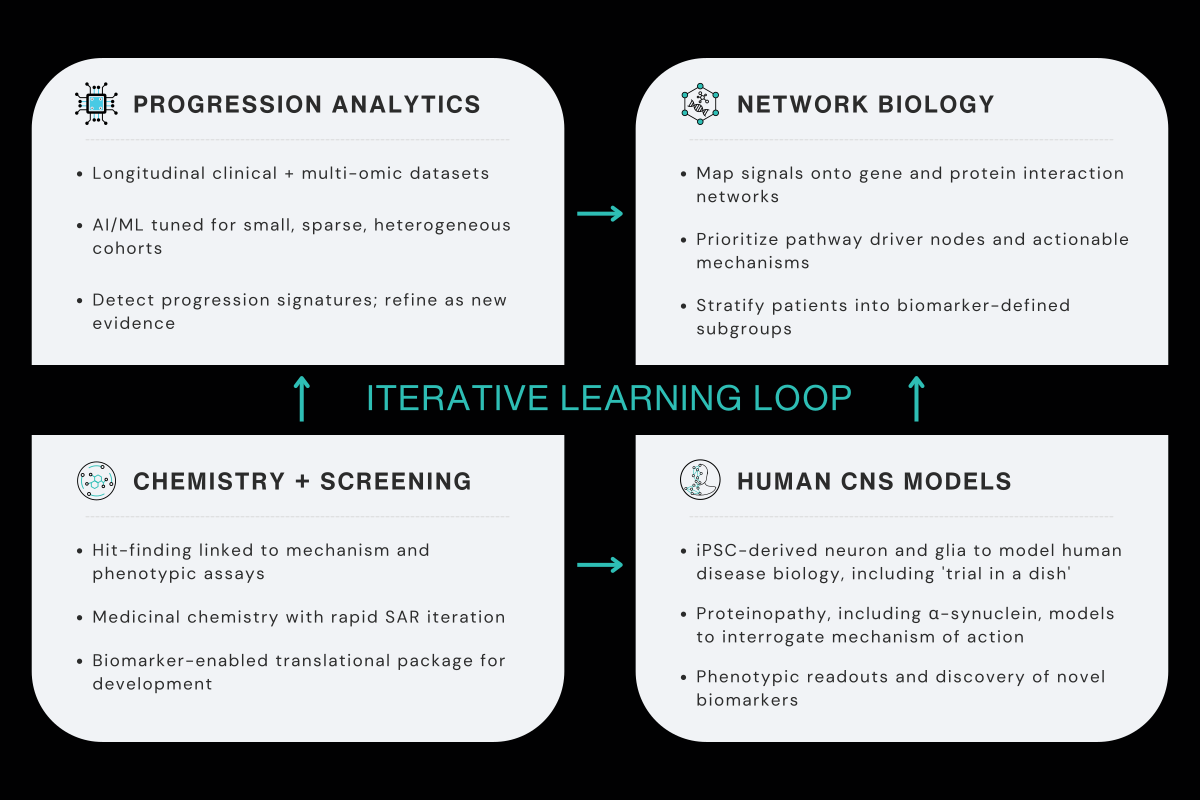
DaCapo Brainscience is focused on applying its proprietary discovery platform – an in vitro model of neurodegenerative disease that recapitulates human biology. Our model is being used to decipher how and where to affect disease progression and resilience using human genomes and cells. From here, we can identify and develop small molecule therapies, as well as potential antisense oligonucleotides (ASOs), antibodies, or other modalities, capable of slowing or halting progression of neurodegenerative disease. This discovery platform functions as a ‘trial in a dish’ that specifically integrates progression analytics, network biology, and human CNS models:
Targeting Sporadic Parkinson’s Disease
Using our platform, we have identified the first known drug target linked specifically to progression in sporadic Parkinson’s disease. This target connects directly to a-synuclein biology and a disease-associated pathway, the disruption of which can lead to unwanted protein misfolding, synaptic dysfunction, and neurodegeneration.
Approximately 1.1 million people in the United States live with Parkinson’s disease. We estimate that a therapy directed against our proprietary target has the potential to impact disease progression in up to 30% of patients with sporadic Parkinson’s disease. Sporadic Parkinson’s is the most common form of the condition, arising without a defined inherited mutation.
Importantly, this target also serves as a compelling biomarker for patient stratification, enabling more precise clinical trials and thus increasing the probability of success.
This work is supported in part by a grant from the Michael J. Fox Foundation for Parkinson’s Disease Research. DaCapo is currently screening brain-penetrant small molecules against its proprietary target.

